Note to the Reader
This chapter will feel unconventional compared to other chapters within our Words of Plainness writings. What follows is not a chapter that has "arrived at" conclusions. It is a demonstration of the nature of "Our Search" in action, focused on the personal growth of Aaron, the primary writer.
I, Aaron, first wrote about the most important life questions we all seek to answer—the subject of chapter two—more than two decades ago, when I was in my early thirties. I was just beginning my teaching career and my children were very young. My brother, in his forties, had traveled somewhat further down a similar career path, but we lived on opposite ends of the country.
In those days of writing alone, I had already been ministering the gospel of Jesus Christ for more than fifteen years. I had genuine conviction then, and much of what I wrote still rings true. But the "refiner's fire" described in Malachi has shaped and molded my understanding and sensibilities.
More than two decades of maturing ministry, interfaith dialogue, teaching high school sciences, and the unique crucible of ordinary living and raising a family within evolving communities have all done their work on my soul. Some of my earlier certainties have been tempered. Others have deepened in unexpected ways. Now, in my fifth decade of life, I recognize a significant softening of my ego, making room for a compassion—empathy even—that feels less like a choice and more like a reflex. This character trait has finally settled into my bones, becoming a visceral recognition that my own spiritual growth is bearing the "fruits of the Spirit.".
Rather than erase my earlier voice or pretend that I have arrived at final answers at this stage of my life, we have chosen to present both: the questions as I framed them then, and the spiritual wrestling I continue with now. You will encounter my younger voice—from my thirties—in regular text, and my current voice—now in my fifties—following each section.
I do this because "Our Search" is the point of this chapter. Some refer to this "Search" as their spiritual "Journey" or "Path." It is not easy or comfortable to grow spiritually. This is illustrated beautifully from the life story of the prophet Enos in the Book of Mormon, who wrote, "I will tell you of the wrestle which I had before God," for "my soul hungered.".
If these Words of Plainness presented only firm conclusions as final declarations of truth, they would betray their subject. The hunger we share—for meaning, for truth, for something substantial enough to stake our lives on—is not a problem to solve in a single go. This personal searching and striving is not a "One and Done" experience. It is a necessary, ongoing tension to live within. The traditions that sustain people do not offer final answers but livable frameworks.
Your spiritual journey is your own. I will not hijack it. My hope is only that seeing one person's search across time—with its clarifications, revisions, and enduring convictions—might give you permission, and a sense of companionship, to pursue your own search.
We are fellow searchers. Let us begin.
Thesis 1: The Hunger Within
From My Earlier Writings
Central to the human experience is a profound hunger for greater understanding, a nobler purpose, and enduring satisfaction with life. Tragically, the noise and worries of daily living often deafen us to this yearning. Yet as we experience life, many of us eventually awake to the realization that selfish pursuits and common pleasures are ultimately unsatisfying. We deeply need more than these can offer. To the searching and discontented soul there seems to be a famine of truly meaningful experiences in the world, a drought of something substantial to satisfy the driving thirst of the human heart.
We all occasionally feel that something is not quite right with life, even when things are going well—as if something is missing. This can become a mournful itch that we do not know how to scratch. Have you ever felt like there is more goodness and nobility inside you than is apparent? Have you ever felt longings, like homesickness, without any explanation? These longings are a normal and healthy part of the human experience. There are times in our lives when we become especially thoughtful, and we think about the nature of our existence. There are as many reasons to contemplate life as there are people. Many devote much energy and time to the search for truth and meaning.
The most basic reason to improve our understanding is for simple survival. Many of us feel driven to learn and explore by curiosity or even boredom. Some seek to lessen pain resulting from a traumatic experience or loss, while others fear death. Many of us seek for something more authentic, some meaningful and lasting cause for which to hope or to work. Others may feel empty or lost in life; whatever the reason may be, the desire connected with these thoughtful moments is to gain more perspective on life. We need to define our place in the world, as we all eventually hunger and thirst to live each day with greater purpose and satisfaction.
Twenty-Plus Years Later
Reading these words now, I am struck by what I got right and what I had not yet learned to see.
The hunger is real. I would not soften that claim. After decades of teaching, ministering, and living alongside people from vastly different backgrounds—atheists and believers, scientists and mystics, the wounded and the thriving—I have found this hunger to be universal. That we exist is something we can agree upon. Why we exist is the subject of much debate and passion. What we do with existence defines our character and sense of identity. These three facts form common ground for every searching soul.
What I would add now is this: the hunger itself is not a sign that something is wrong with us. It is evidence that we are awakening spiritually. Those who feel no such hunger may have numbed themselves to it, or they may have found worldview frameworks that satisfy them, at least for a season. Both possibilities deserve respectful tolerance.
I have also come to appreciate a truth my younger self was circling but had not quite grasped: the living traditions that sustain people tend to offer not final answers but an imperfect, incomplete collection of coping skills for survival. This spiritual hunger does not disappear when we find faith or a portion of truth. It transforms. It becomes anticipation rather than anguish. I feel a pleasant sense of "something more" approaching, a developmental shift I cannot fully name but will welcome when I recognize its arrival.
If you recognize this hunger in yourself, know that it is neither weakness nor failure.
Thesis 2: Questions That Demand Answers
It is the evidence of your "aliveness."
From My Earlier Writings
As we search for understanding, we naturally wonder about life's purpose and question the wisdom we've inherited. Many traditions teach that we are born to die, yet we must die to truly live. Mortals live only for a time and then die. Mortality is the limited span of this life, while immortality is eternal life. As seeds of God, we seem to barely have time to take root and blossom in the gardens of mortality. It also seems that we might only mature to bear the fruits of immortality long after our mortal journey ends.
There are many more immediate concerns than our fear of death and hopes for immortality.
Consider these fundamental questions: Who am I? Why am I? What can I become? What is happiness, and how do we find it in this life? Do good and evil really exist as objective realities? What is the true nature of our existence, and what are we becoming? Is there an authority greater than human conscience and desire? In what or in whom can we place our trust? How can we distinguish truth from error?
Twenty-Plus Years Later
These questions still matter. But in recent years, I have found a simpler way to organize them—one that emerged, unexpectedly, through dialogue with an artificial intelligence and refinement in numerous interfaith chats on virtual reality social platforms. When I asked "What questions feel most essential for people to answer so that they can feel like things are okay?" The volume of responses clarified what I had been perceiving for decades.
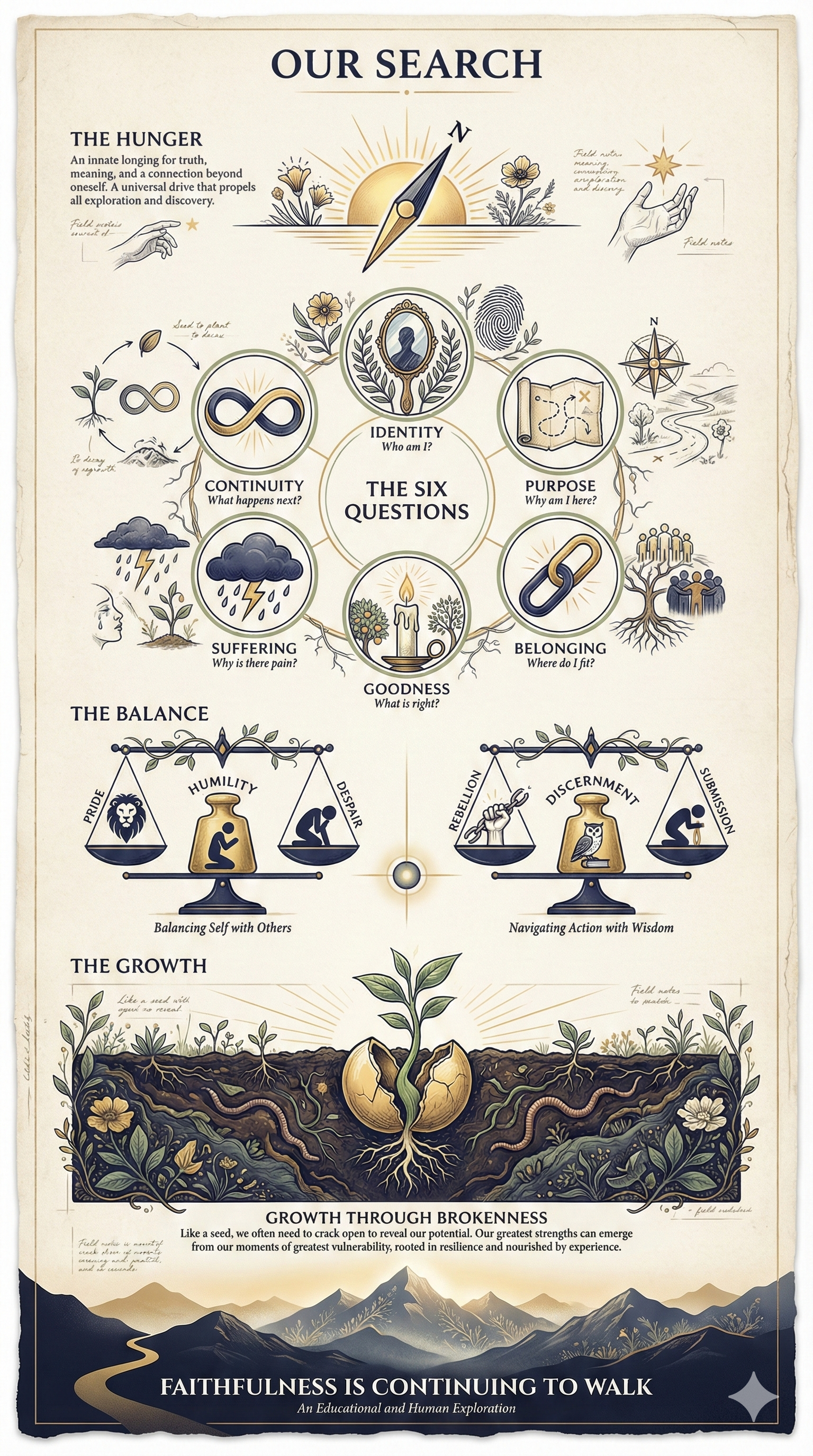
First, identity and worth: Who am I, and do I matter? We need assurance that our existence has significance—that we are not merely interchangeable or accidental. Second, meaning and purpose: What am I here for? Most people need to feel their days add up to something—that their effort and suffering are not arbitrary. Third, connection and belonging: Am I known, and do I belong somewhere? Loneliness is not just uncomfortable; it is existentially destabilizing. Fourth, goodness and moral orientation: What is right, and can I live it? Moral confusion creates deep anxiety and spiritual unrest. Fifth, suffering and coherence: Why do bad things happen, and can I bear them? We can endure remarkable hardship if it fits into a coherent story. And sixth, death and continuity: What happens when I die, and does anything last?
What strikes me is that these are not puzzles to solve only once—they are divinely created existential tensions to live within. I no longer expect to arrive at answers that silence the questions. Instead, I have learned to dwell within them, letting the questions themselves become companions on the journey. Perhaps this is what spiritual maturity looks like: not the accumulation of certainties, but the capacity to hold uncertainty without despair.
Thesis 3: How We Cope
From My Earlier Writings
To satisfy our hunger for truth, meaning, and lasting happiness, we must pursue them directly and honestly. Unfortunately, many of us cope with such hunger by substituting temporary distractions in its place. We have observed several such coping mechanisms in ourselves and in others, including pride, despair, rebellion, submission, and self-justification.
Pride. Competition is a natural part of the human experience. It can be very healthy when combined with wisdom and civility. However, when competition is adopted as the meaning of life, all there is to one's existence is the survival of ego and the pursuit of power, position, and fame. Such competition is a vain attempt to create meaning where none can exist for long.
Despair. A sorrowful way to deal with life is to actively refuse to cope. Some have been overwhelmed by the search for truth to such a degree that they feel confused, frustrated, or even scared—losing hope in ever understanding life.
Rebellion. Some cope by resisting authority or authoritative ideas. While it is healthy to consider ideas independently, many categorically reject traditional wisdom. Rebellion often arises as a response to traumatic or confusing experiences and becomes a defense mechanism rooted in mistrust.
Submission. There is wisdom in carefully evaluating long-held traditions. However, we refer here to those who embrace authority without question or careful thought. Some distrust their own judgment, preferring to be told what to believe.
Self-Justification. We often go to great lengths to excuse our thoughts, feelings, and actions. Many seek self-justification by embracing philosophical systems that validate their choices.
Twenty-Plus Years Later
This section troubled me significantly when I reread it in my fifties. Not because I think the categories are wrong. Pride, despair, rebellion, submission, and self-justification do describe real patterns I see in myself and others. What troubles me is the tone of certainty from my early decades. My younger voice named these distractions as "false substitutes for truth," which implies judgment. It suggests that people who cope this way are making a choice to avoid truth when they could simply choose otherwise.
What I have learned in the last twenty years of teaching, ministry, and simply paying attention is this: most people are doing the best they know how. They live with a mixture of strengths and weaknesses, shaped by their unique backstories and formative experiences. Each person possesses a unique blend of incomplete coping skills, uncertain resources, and shifting social structures. Each of us is also possessed of attitudes and worldviews that might or might not be adaptive to the needs of life. No one is completely evil. No one is completely good.
The person who retreats into pride may have learned early that vulnerability invites harm. The person who sinks into despair may have been genuinely overwhelmed by losses no one should have to bear alone. The rebel may have been burned by authorities who violated sacred trust. The one who submits may have never been given permission to think their own thoughts. The self-justifier may be carrying shame so heavy that facing it directly would break them.
These are not failures of will. They are survival strategies, bookmarks of safety in our story of healing and progress. They deserve compassion, not condemnation.
This does not mean we should remain in patterns that harm ourselves or others. Growth is possible. I have witnessed it literally thousands of times in my students, and experienced it myself. But growth rarely comes through being told we are doing it wrong. It comes through being met with understanding, being offered better tools, and being invited into communities that hold space for both our wounds and our healing growth.
If you recognize yourself in any of these patterns, please hear me: you are not broken. You are surviving. And surviving is the first step toward thriving.
Thesis 4: The Path Forward
From My Earlier Writings
All of these coping mechanisms can become artificial substitutes for the genuine discovery of truth, wisdom, and happiness. We must pause to evaluate ourselves periodically. Embracing extremes of pride, despair, rebellion, and submission can cripple the soul. Wisdom lies in avoiding extremes and finding the balanced middle path. For example, humility is in the balance between pride and despair. Another example would be independent judgment, which lies in the balance between rebellion and blind submission.
We invite you to embrace the search with honest humility. Even when we grasp important truths, vast understanding still awaits discovery. We assure you that truth is knowable, and enduring happiness can be found in this life. Renew your search with courage and hope, remembering the promise: "Ask, and it shall be given you; seek, and ye shall find." "Our search" is worth any sacrifice. These things we testify in the name of Jesus Christ, Amen.
Twenty-Plus Years Later
The balance my younger self described is real: humility between pride and despair, independent judgment between rebellion and submission. This principle has guided my life and I still teach it. My thousands of students will recognize—and probably roll their eyes with a smile at—the numerous repetitions of my personal catchphrase: "Truth, health, and wisdom are usually somewhere in the middle of extremes." My teaching style was to require the application of this principle in the science classroom and laboratory as I helped young minds understand natural principles, like: dynamic equilibrium in physical science, homeostasis in biology, and sustainability in environmental science.
What I would now add to this chapter is that finding balance in spiritual development is not a destination but a practice. For example, we do not arrive at humility and then possess it forever. We practice humility, daily, in the face of our recurring temptations toward either pride or despair.
The opposition in all things—whether viewed as wisdom in science or spirituality—is the tension between what we are and what we might become. This dynamic tension is woven into the structure of existence itself. It is not an obstacle to development but the very means of growth. I now see mortality as a learning experience for our spirits. And the Creator—the Master Teacher—wrote these conditions of opposition as the curriculum of our mortal education.
I still believe what I wrote decades ago: truth is knowable. Enduring happiness can be found. Ask, and it shall be given. Seek, and you shall find.
But I have also learned that asking and seeking look different than I once imagined. They are less like solving a puzzle and more like cultivating a relationship. They require patience, humility, and the willingness to be surprised—even by the source of the answers.
Another personal milestone has been settling into a humble confidence in God—one that doesn't depend on having final answers to life's important questions. I have become less concerned about formalized creeds and official doctrines, though they are still a source of puzzling fascination to me.
With or without perfect understanding of "correct" theology, I have accepted Jesus Christ as my divine and living Savior. Whether or not others approve, I will follow Him. I feel His peace. I perceive God's power and Spirit operating in my life. Whether I am accepted by particular traditions or philosophies has no bearing on my view of their adherents as fellow children of God, for I see them as brothers and sisters, fellow searchers.
The Gift of Holy Dissatisfaction
There is something I did not understand when I first wrote about the hunger within us. I described it accurately—the restless longing, the sense that something is missing even when things are going well, the itch we cannot scratch. But I did not yet see it for what it truly is. It is a divine gift and an essential component of a plan based on divine wisdom that is beyond our own.
Consider: God created us with moral agency—the capacity to choose. He placed us in mortal conditions of opposition in all things—light and dark, pleasure and pain, growth and decay. These are well-established principles of both the gospel and science. But there is a companion gift to agency that I had not fully appreciated: The Creator also made us unable to remain satisfied for long with any level of accomplishment or personal development.
This is not a curse. This is not evidence that we are broken or ungrateful or missing the point. It is the deliberate design of a wise God who is the literal parent of our spirits—the divine pedagogy of a divine teacher.
"Blessed are they which do hunger and thirst after righteousness: for they shall be filled." Why would a loving Creator build restlessness into our souls? Because creation is not yet finished.
We are still being created—shaped, refined, and polished. The process that began before mortality does not conclude in mortality. We will continue to develop eternally.
If we could reach a point of complete satisfaction—a state where we felt no pull toward growth, no hunger for more light and truth—we would stop becoming what we are meant to become. The restlessness is not a flaw. It is the engine of eternal progression.
The Safety Net of Grace
But here is where the good news of Jesus Christ becomes essential. If we are perpetually stretched toward growth, perpetually placed in conditions of opposition, perpetually invited to exercise agency in a world designed to challenge us, then we will inevitably make mistakes and eventually be held accountable.
This is not pessimism. It is the nature of an educational environment where the curriculum requires risk, choice, and the possibility of failure.
The good news is that we can recover from mistakes. Through the grace of Christ's atonement, we can recover and grow. He has promised never to give up on us. The prophet Malachi described Him as one who would "sit as a refiner and purifier of silver." The Lord patiently, attentively, watches us over the refining fire until the impurities are drawn out and His own image can be seen reflected in us.
This divine transformation—named in various traditions as sanctification, theosis, purification, insight, discipleship, consecration, holy anointing, and more—happens through the power of the Holy Ghost, the Spirit of Truth. It is not instantaneous. It is not comfortable.
And it is not completed in this life; it continues beyond the veil of death. The resurrection is not the end of development; it is the next phase.
God Loves Broken Things
I admire a musical testimony by Kenneth Cope. He captured something essential in his song "Broken." He writes that broken clouds give rain, broken soil grows grain, broken bread feeds us for one more day. Broken storms yield light. The break of day heals night. Broken pride turns blindness into sight. The refrain is simple and profound: God loves broken things.
The lyrics help me as I attempt to explain my own awakening to this principle. For years I had thought of brokenness as the problem and Christ as the solution—as if the goal were to be fixed and then remain unbroken.
But the pattern of creation itself suggests otherwise. Seeds must break open to grow. Bread must be broken to nourish. Hearts must be broken to become capable of deeper love. The most holy of sacrifices we can give to God is a "broken spirit: a broken and a contrite heart" (Psalm 51:17, 3 Nephi 9:20). This, He can work with.
The hunger we feel, the dissatisfaction with any resting place, the holy restlessness that drives us forward—this is the breaking that makes growth possible. Christ does not stand at the end of the process, waiting to congratulate us when we finally get it right. He walks with us through every breaking—every reformation—every new becoming.
"He will sit as a refiner." Not standing apart. Sitting. Attentive. Present. Patient. Participating. Masterful. Watching until the work is done—and the work is never done, because we are eternal beings with infinite potential.
The Invitation
So when you feel the hunger return after accomplishing something meaningful and find yourself quickly restless for more, do not interpret this as failure. Do not assume you missed something or chose the wrong path. This restlessness is a gift. It is the voice of your eternal nature refusing to settle for less than what you are capable of becoming.
And when you stumble, when you make mistakes in this mortal educational environment—as all of us do—know that the Refiner sits beside his holy fire, watching, waiting, ready to continue the work whenever you willingly return to Him. He has promised not to give up on us. The process of sanctification does not conclude in this mortal life. There is eternity. There is grace. There is always another invitation to move forward.
Creation is not finished. Neither are you. Neither am I. And that, I have come to believe, is very good news.
To My Fellow Searchers
I do not know where you are in your search. Perhaps you are just beginning—overwhelmed by questions that seem to have no answers. Perhaps you are deep in the middle—having found some things but still hungry for more. Perhaps you have wandered for years and are tired—or even angry.
Wherever you are, know this: the search itself is meaningful. The hunger you feel is evidence of your aliveness. The questions that haunt you are invitations, not accusations.
I have not arrived at my final destination. Neither, I suspect, have you. But we are on our way, together. And perhaps that is enough.
Here is what I am still discovering: That compassion for others begins with compassion for myself. That conviction and humility can coexist. That the Creator's wisdom can be read in the Creation if we have eyes to see. That unexpected conversation partners—even virtual or artificial ones—can illuminate what we have long sensed but not yet named. What are you discovering? Our search continues along the straight and narrow path. May we find one another along the way is my prayer these days.
A Promise I Hope to Fulfill
If I am blessed to remain in this mortal educational environment for another twenty years, I am confident that I will need to revise this chapter again to reflect yet another cycle of spiritual wrestlings and personal growth. I testify of my confidence in the divinity of the process—confidence in "Our Search," in the name of Jesus Christ. Amen.